From a Single Photon to a Product: Physics Expands Sensing and Communication
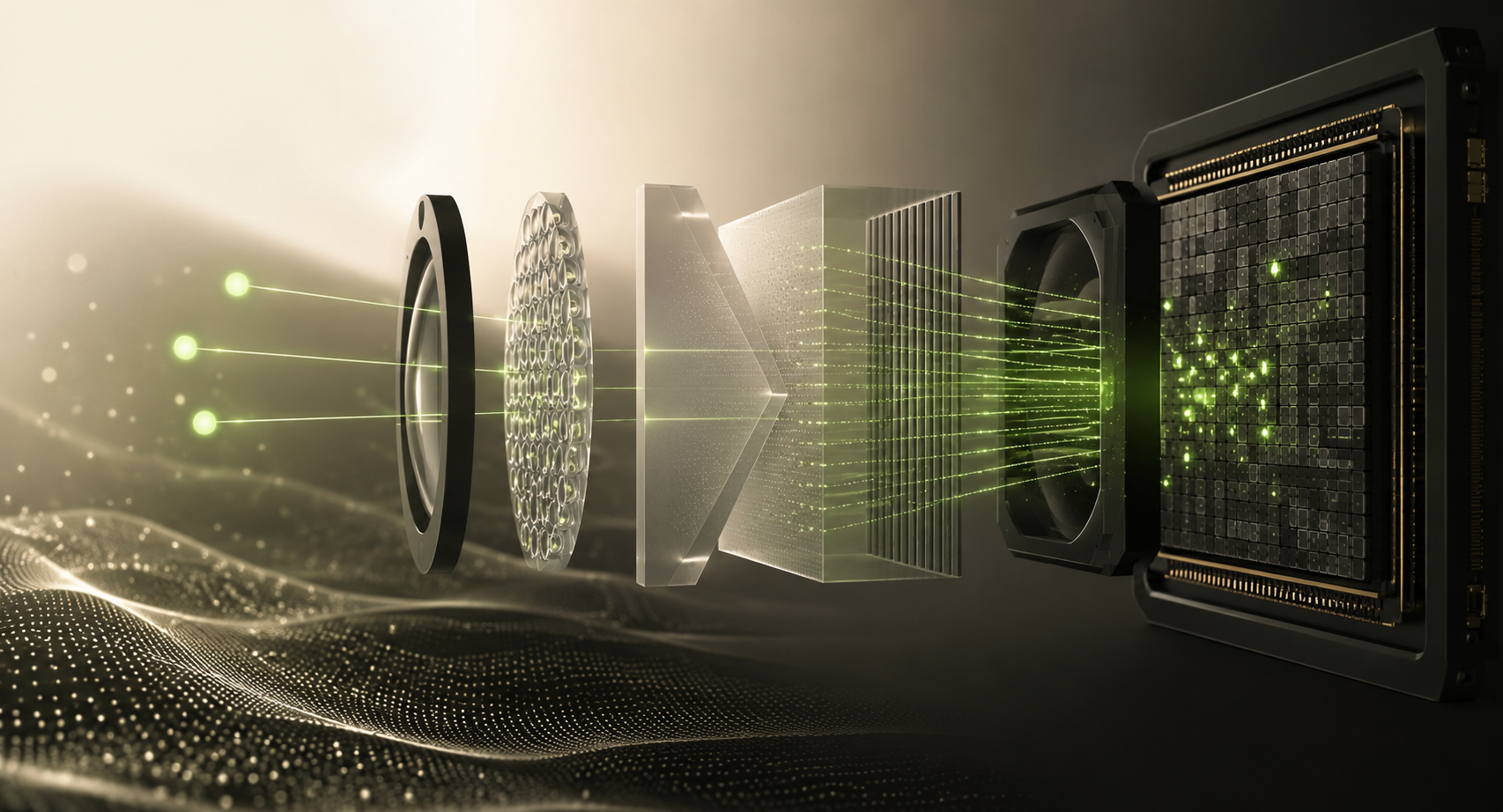
Detecting light at the level of individual photons gives cameras, depth sensors, communications and scientific instruments new capabilities.
Seeing very little light
SPAD detectors can register weak light events and time them precisely, supporting distance measurement and imaging in difficult conditions.
The complete system
A detector is not a product. Optics, electronics, algorithms, calibration and interface determine range, resolution, power and cost.
From laboratory to device
Physical innovation matters when it is manufacturable, repeatable and robust outside perfect conditions. Packaging and testing can matter as much as discovery.
A connected impact
Precise sensing can improve robotics, mobile devices, healthcare and infrastructure. When the data reaches the web, standards and privacy become part of the system.
From photon detection to meaningful information
A single-photon avalanche diode produces an electrical event when it detects light, but the raw event stream contains dark counts, afterpulsing, ambient light and timing variation. Useful information emerges through signal processing and statistical estimation. In time-of-flight imaging, for example, the system sends controlled light and estimates distance from the return-time distribution. Multiple weak observations can be combined into a reliable depth map, provided the model accounts for noise and reflectivity. This is a powerful example of hardware and mathematics co-design: detector characteristics influence the algorithm, while computational methods can relax some hardware constraints. The final product is therefore not merely a sensor chip. It is an integrated stack of illumination, optics, electronics, timing, inference and calibration designed around a specific decision the device must make.
Engineering trade-offs for real devices
Consumer and industrial products operate under strict limits on eye safety, power, size, temperature and cost. Increasing illumination may improve range but consume more energy; a larger detector array may improve resolution while increasing data volume and heat. Highly sensitive pixels can also saturate in bright conditions. Engineers balance these variables using optical filters, gating, adaptive exposure and on-device processing. Manufacturing variation creates another challenge because millions of pixels must behave consistently enough for the algorithm to interpret them. Calibration at the factory and self-correction in the field can become central product features. These trade-offs explain why a scientific breakthrough and a mass-market capability may be separated by years of engineering. The innovation is complete only when the system performs predictably in the hands of ordinary users.
Photonics as part of the connected web
Depth and low-light sensing can improve robotics, accessibility, medical devices, infrastructure inspection and spatial interfaces. Once measurements flow into connected applications, however, the design expands beyond optics. Developers must decide what processing happens on the device, what leaves it, how long it is retained and whether a person can understand or challenge an automated interpretation. High-dimensional sensor data can reveal more than the feature a user requested, so privacy should begin with data minimization and edge processing where practical. Web standards can then expose useful results through interoperable, accessible interfaces rather than locking them inside one device ecosystem. Photonics creates a richer digital view of the physical world; responsible web engineering determines whether that view becomes trustworthy and broadly useful.
Design principles for a sensing product
A team building with advanced photonics should begin from the environment, not the detector specification. Sunlight, reflective surfaces, motion, dust, temperature and device orientation all shape the signal. The product requirement should state what decision must be made, at what distance and speed, with which acceptable error rates. From there, engineers can allocate performance across optics, illumination, sensing and computation. Privacy and safety reviews should happen at the same stage because they influence architecture: on-device processing may reduce data exposure, while eye-safety limits affect illumination and range. The interface should communicate uncertainty when the measurement is used for a consequential action. Field testing needs diverse conditions and a process for discovering failure patterns after release. A strong sensing product does not pretend that every frame is perfect; it detects when confidence is low and selects a safe response. This combination of physics, software and responsible product design is what turns individual photons into a capability people can depend on. This analysis is designed as a practical decision framework, not a prediction or a substitute for specialist advice. The technologies discussed here evolve quickly, and their value depends on the institution, jurisdiction, users and operating environment in which they are deployed. A useful next step is to convert the central ideas into testable assumptions: define the outcome that matters, record the present baseline and identify the smallest experiment that can produce credible evidence. Include people who operate the existing process as well as those designing the new one, because they often understand different parts of the risk. Document what would cause the team to continue, change direction or stop. Ask what information must remain accurate, who can correct it, which component is a single point of failure and what safe behavior looks like when that component is unavailable. Good innovation is not a performance of certainty. It is a disciplined process for learning faster while remaining accountable for the consequences. When technology, governance, operations and a clear public promise are designed together, innovation becomes easier to adopt, easier to evaluate and more resilient when conditions change. Implementation should be reviewed in stages. The first stage establishes shared definitions and a measurable baseline. The second tests a limited workflow with real operating constraints and explicit safeguards. The third examines exceptions, security failures and recovery rather than demonstrating only a successful path. The final stage evaluates whether the evidence supports scale. At every stage, teams should preserve decision records and publish an understandable explanation for the people affected. Metrics need an owner and a response: collecting a dashboard without deciding what action follows from a threshold creates observation, not control. Independent review is useful when claims are consequential or when the same group designs, operates and evaluates the system. Leaders should also reserve time and budget for maintenance, because models drift, dependencies change and standards evolve after launch. This lifecycle perspective connects technical ambition with institutional memory. It makes progress visible while protecting the option to correct course before a weakness becomes embedded at scale. A final review should compare the delivered outcome with the original baseline and record the lessons that should shape the next investment decision.